
Mason
Roseburia
Builds with what you provide
Roseburia is a genus of gut bacteria linked to fibre fermentation and the production of butyrate — one of the short-chain fatty acids produced in the gut.
Think of it as a Mason: it takes the components delivered with your diet and uses them in processes whose products include butyrate. But the Mason does not work alone. Its significance depends on the whole microbiome ecosystem.
Your microbiome builds something every day.
Fermentation goes on constantly in the gut. Bacteria use the components that arrive with your diet and turn them into various metabolites.
One of them is butyrate — a short-chain fatty acid that is an important element of gut biology.
This is one example of how food, bacteria and metabolites form a network of relationships.
- Fibre
- Fermentation
- Roseburia
- Butyrate
- Gut environment
A simplified diagram. The real microbiome is thousands of species and millions of relationships.

Meet Roseburia
Roseburia includes bacteria linked mainly to the fermentation of dietary fibre components. Some species can use hemicellulose and starch, among others.
One product of their metabolism can be butyrate — a metabolite of interest to scientists studying the gut microbiome.
His superpower?
Producing butyrate during fibre fermentation.
Butyrate is one of the main short-chain fatty acids produced by bacterial fermentation in the large intestine.
The Mason works with the material that reaches his environment
- Fibre: vegetables, pulses, wholegrains
- Fermentation
- Roseburia
- Butyrate
- Gut cells — a source of energy
Butyrate is used by gut cells as a source of energy and takes part in processes related to the gut environment. That does not mean one bacterium is “responsible for a healthy gut”. The whole community of microorganisms matters.
Good building material matters
These foods provide components the microbiome can use — they do not “increase Roseburia”.
Fibre
Roseburia is linked to fibre fermentation, so the availability of suitable substrates matters for its metabolism.
Varied plant foods
Vegetables, fruit, pulses, seeds and wholegrains provide different kinds of carbohydrates and fibre.
Variety
The microbiome does not need one magic product. Different bacteria use different components.
The whole ecosystem
Roseburia is part of a network of microorganisms that can use each other’s metabolic products.
When does the Mason have less to work with?
There is no single list of foods that “destroy Roseburia”. Its presence and function depend on many factors: diet, gut environment, medicines and the other microorganisms.
Little fibre
May mean less availability of the substrates used in fermentation.
A monotonous diet
Limits the variety of components reaching the microbiome.
Antibiotic treatment
Can significantly change the microbiome, and recovery after treatment is individual.
Sudden dietary changes
A large increase in fibre can temporarily affect gut comfort. That is why changes are best made gradually.
The Mason does not build alone.
In the microbiome one bacterium can be part of a longer chain of transformations. Microorganisms can take part in cross-feeding — the metabolic products of some bacteria can be used by others.
Bifidobacterium → intermediate metabolites → Roseburia → butyrate → other parts of the ecosystem. That is why at GutLoop we are interested not only in a single microorganism but in the network linking bacteria, metabolites and diet.
One bacterium can prepare something the next one will use.
GUT·DIET·MAP
These are exactly the relationships our knowledge map helps us chart: bacterium ↔ metabolite ↔ food.


Where might Roseburia matter?
The areas in which science studies the links between Roseburia, butyrate and how the body works.
Digestion and the gut environment
Roseburia is linked to fibre fermentation and butyrate production, which makes it of interest to scientists studying the gut microbiome.
Gut barrier and immunity
Butyrate is studied in relation to the gut lining and immune response.
Metabolism
SCFAs, including butyrate, are studied in relation to host metabolism and communication between the microbiome and the body.
Body weight
Microbiome composition and its metabolites are studied in relation to energy metabolism and body weight. The presence of Roseburia alone, however, cannot predict whether someone will lose weight.
Gut–brain axis
Metabolites produced by the microbiome are one element of the communication studied between the gut, the immune system and the nervous system.
What does your result show?
In the test we check the presence and relative abundance of Roseburia in your microbiome profile.
The result is not a stand-alone health assessment. We interpret it together with the other microorganisms, microbiome indicators and information about your diet and lifestyle.
Detected in lower relative abundance than the adopted reference range. A signal worth interpreting together with the rest of your profile and how you eat.
Within the adopted reference range. One element of your profile — it does not in itself mean everything is “perfect”, just as lower abundance does not mean disease.
Higher relative abundance in your profile. It does not automatically mean a benefit or a problem — we interpret it in the context of the whole ecosystem.
The bar only illustrates the three interpretation ranges, not your result. We define the reference range from population data and our research; it may be updated.
The result shows where you are. GutLoop helps you decide what next.
If your profile points to areas worth supporting, recommendations may concern dietary variety and fibre sources, among others.
It is not about “feeding one bacterium”. It is about creating conditions that favour the whole ecosystem.
Example type of recommendation — if your profile points to an area worth supporting
- 🥦 More varied plants
- 🫘 More fibre sources
- 🌾 Wholegrain products
- 🌱 Gradually increasing dietary variety
Illustrative example. GutLoop recommendations depend on the whole profile, questionnaire, goals and lifestyle, not on the level of one bacterium.
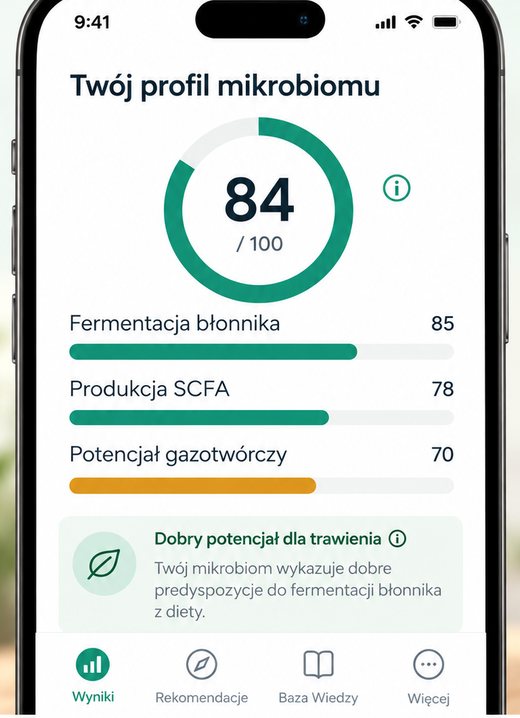
Your Mason
| Presence | detected |
| Relative abundance | [level] |
| Context | [interpretation] |
This is what your Mason looks like in GutLoop
Your result. Your diet. Your recommendations. After the test you will see the Mason as part of your individual profile — with context and related processes.
- Your result · presence and relative abundance of Roseburia in your profile.
- Interpretation · what this element may mean in the context of your whole microbiome.
- Related areas · Fibre fermentation · Butyrate · SCFA
- Recommendations · always in the context of the whole profile.
This is not a separate “bacterium rating”. It is part of your individual microbiome profile.
The hero’s story · 0:45 · video coming soon
Meet the Mason
“Hi! I’m the Mason. I don’t build houses. I build… or rather co-create something much smaller. I work with the fibre that reaches the gut and take part in fermentation. One product of my work is butyrate. And the best part is that I don’t work alone. In our world one bacterium can prepare something the next one will use. That is why in the microbiome the whole team counts. Want to see what yours looks like? Test your microbiome.”
The film is a storytelling layer. It is a simplified way of talking about biology — the real microbiome is far more complex.
Want to go deeper?
Articles linked to the hero: science without shortcuts, in language you can understand.
Fibre and the microbiome — what really happens in the gut?
From plate to fermentation: fibre’s journey through the digestive tract.
Coming soon
Butyrate — why do scientists talk about it so much?
A short-chain fatty acid, gut cells and what follows.
Coming soon
Microbiome and digestion — how do bacteria ferment fibre?
Where gas and bloating come from and why changes are best made gradually.
Coming soon
The Mason is only one inhabitant of your microbiome.
A much bigger team works in your gut. GutLoop helps you see its composition, understand the relationships and turn data into everyday actions. Get to know your microbiome.