
Gardener
Akkermansia
Tends the environment others live in
Akkermansia is a genus of bacteria whose best-known member — Akkermansia muciniphila — is associated with the gut mucus layer. It uses mucins, components of the mucus produced by the body, as substrates.
Think of it as a Gardener: it works in the layer that separates the inhabitants of the microbiome from the gut lining. But the Gardener does not act alone — its significance depends on the whole ecosystem.
Your gut has its own garden.
The gut lining is covered by a mucus layer that separates microorganisms from the body’s cells. This layer is constantly renewed and is home to some inhabitants of the microbiome.
Some bacteria can use components of the mucus, and their products can be used by other microorganisms. Diet, the microbiome and the mucus layer constantly interact.
That is why at GutLoop we never look at one bacterium in isolation. We look at the whole environment it lives in.
- Diet
- Microbiome
- Mucus layer
- Gut barrier
- Body
A simplified diagram. The real microbiome is thousands of species and millions of relationships.

Meet Akkermansia
Akkermansia muciniphila was described relatively recently and has been intensively studied in recent years. Its hallmark is the ability to break down mucins — the glycoproteins that form the gut mucus layer.
Products of these processes include acetate and propionate — short-chain fatty acids that other microorganisms can use.
His superpower?
Can live in the mucus layer and use its components, taking part in its natural renewal cycle.
Akkermansia is studied in relation to the gut barrier and metabolism. Results are promising but still accumulating — we do not treat it as “the metabolic health bacterium”.
The Gardener works in a layer you cannot see
- Mucins (gut mucus)
- Akkermansia
- Mucin breakdown
- Acetate, propionate
- Other bacteria and the gut environment
The mucus layer is constantly renewed by the body. Research suggests that mucin-using bacteria may be part of this natural cycle.
What suits the Gardener?
There is no single food that “increases Akkermansia”. There are, however, dietary components that research links to an environment favourable to this group.
Polyphenols
Berries, grapes, cocoa, tea and olive oil provide compounds that research links to a gut environment favourable to Akkermansia.
Fibre and plant foods
Vegetables, fruit, pulses, seeds and wholegrains provide substrates used by the whole microbiome.
A varied diet
Different components mean different substrates for different inhabitants — including those whose products the Gardener uses.
Stable habits
The microbiome responds to how you eat over the long term, not to a single meal.
What may not suit it?
There is no list of foods that “destroy” Akkermansia. Its presence depends on the whole gut environment, and responses are individual.
A diet poor in plant foods
Less fibre and fewer polyphenols can mean fewer varied substrates for the whole ecosystem.
Antibiotic treatment
Antibiotics can significantly change the microbiome; the pace and extent of change are individual.
Changes in the gut environment
The state of the mucus layer, other microorganisms and medicines can affect the conditions Akkermansia lives in.
Individuality
What happens to Akkermansia in one person does not have to look the same in another.
The Gardener does not act alone.
The products of mucin breakdown — acetate and propionate among them — can be used by other bacteria, including butyrate producers such as Faecalibacterium and Roseburia.
In turn, the mucus layer Akkermansia lives in is renewed by the body, and its state depends on the whole gut environment.
That is why the presence of one bacterium never tells the whole story.
GUT·DIET·MAP
These are exactly the relationships our knowledge map helps us chart: bacterium ↔ metabolite ↔ food.


Where might Akkermansia matter?
We show the areas in which science studies Akkermansia’s links with how the body works — without promising effects.
Gut barrier and immunity
Akkermansia lives in the mucus layer, so it is one of the bacteria studied in relation to the gut barrier and its interaction with the immune system.
Metabolism and blood sugar
Akkermansia is one of the most studied microorganisms in relation to metabolism. Research is ongoing and we interpret the results cautiously.
Body weight
Microbiome composition, including Akkermansia, is studied in relation to body weight. That does not mean the level of one bacterium can predict whether someone will lose weight.
Digestion and the gut environment
Metabolites produced in the mucus layer are part of the processes in the gut environment.
Do you have your Gardener?
In the test we check whether Akkermansia is present in your microbiome profile and how its relative abundance compares with the adopted interpretation range.
Akkermansia is sometimes undetected in healthy people. The level of one bacterium alone does not say whether your microbiome is “good” or “bad”.
Detected in lower relative abundance than the adopted reference range. A signal worth interpreting together with the rest of your profile and how you eat.
Within the adopted reference range. One element of your profile — it does not in itself mean everything is “perfect”, just as lower abundance does not mean disease.
Higher relative abundance in your profile. It does not automatically mean a benefit or a problem — we interpret it in the context of the whole ecosystem.
The bar only illustrates the three interpretation ranges, not your result. We define the reference range from population data and our research; it may be updated.
We don’t grow one bacterium. We tend the whole garden.
GutLoop does not give you a list of foods “for Akkermansia”. It combines information about your microbiome with your diet, goals and lifestyle to point to areas you can support.
The goal is not “more Akkermansia”. The goal is an environment in which the whole ecosystem has something to live on.
Example type of recommendation — if your profile points to an area worth supporting
- 🍇 More polyphenol-rich foods: berries, cocoa, tea, olive oil
- 🥦 Varied plant foods
- 🌾 Different fibre sources
- 🔄 Make changes gradually
- 📊 Watch the whole profile, not just one bacterium
Illustrative example. GutLoop recommendations depend on the whole profile, questionnaire, goals and lifestyle, not on the level of one bacterium.
Your Gardener
| Presence | detected |
| Relative abundance | [level] |
| Context | [interpretation] |
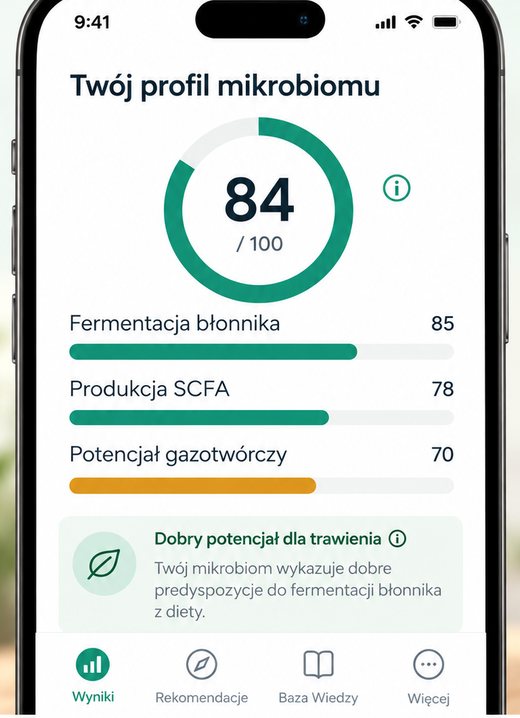
This is what your Gardener looks like in GutLoop
After the test your microbiome profile becomes part of the app, where you can see your results, their context and recommendations.
- Your result · presence and relative abundance of Akkermansia in your profile.
- Interpretation · what this element may mean in the context of your whole microbiome.
- Related areas · Mucus layer · Gut barrier · Acetate and propionate
- Recommendations · always in the context of the whole profile.
This is not a separate “bacterium rating”. It is part of your individual microbiome profile.
The hero’s story · 0:45 · video coming soon
Meet the Gardener
“Hi. I’m the Gardener. I work where few people look — in the mucus layer lining your gut. I don’t build it myself; your body renews it constantly, and I use what is in it. What I leave behind, other inhabitants gladly use. Want to see whether I’m in your garden? Test your microbiome.”
The film is a storytelling layer. It is a simplified way of talking about biology — the real microbiome is far more complex.
Want to go deeper?
Articles linked to the hero: science without shortcuts, in language you can understand.
The gut barrier — what forms it and how is it studied?
Mucus layer, epithelium and microorganisms: how the boundary between gut and body works.
Coming soon
Microbiome and metabolism — where does the link begin?
What bacteria, metabolites and blood sugar have in common.
Coming soon
Microbiome and body weight — what do we really know?
Why the presence of one bacterium does not predict whether someone will lose weight.
Coming soon
The Gardener is only one inhabitant of your microbiome.
Your real profile is far more complex. GutLoop analyses it as a whole ecosystem — combining the microbiome, data about you, diet, goals and our map of relationships. Get to know your own microbiome.