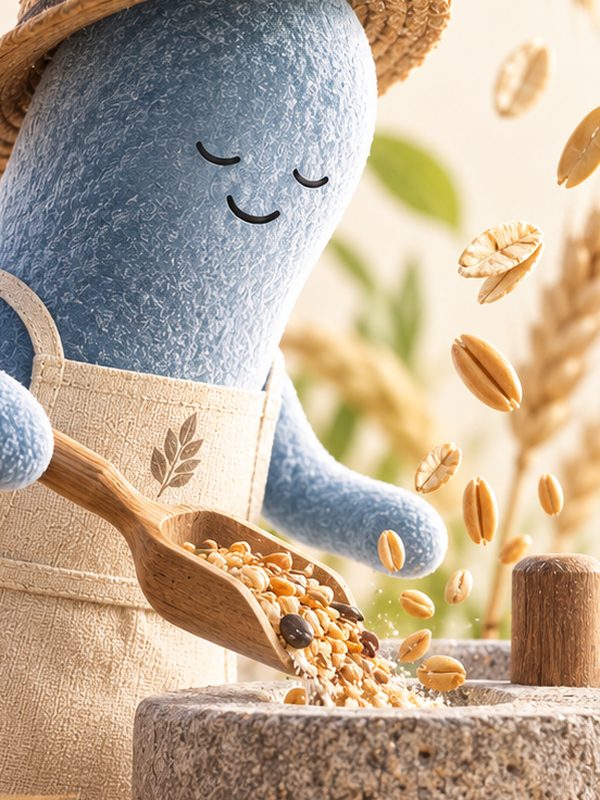
Miller
Bacteroides
Grinds what we cannot digest ourselves
Bacteroides is one of the most important genera of bacteria living in the human gut. Many of its members can use complex polysaccharides — components our body cannot fully digest on its own.
Picture it as a Miller: it processes large, complex molecules into smaller components the microbiome can then use. And because every mill works a little differently, what matters is not only its presence but the exact microbiome profile of a given person.
Your body does not digest everything on its own.
Some plant components, especially complex polysaccharides, are not fully digested in the upper digestive tract. They travel on — to the large intestine, where they become material for microorganisms. And this is where the Miller’s work begins.
This is one reason fibre is not simply “something we don’t digest”.
For the microbiome it can be an important source of material to work on.
- Food
- Complex polysaccharides
- Microbiome bacteria
- Fermentation + metabolites
- Further processes in the ecosystem
A simplified diagram. The real microbiome is thousands of species and millions of relationships.
Meet Bacteroides
Bacteroides is a large and diverse genus of bacteria in the human gut. Many of its members have an extensive set of enzymes for using various complex carbohydrates and polysaccharides.
This allows Bacteroides to take part in processing dietary components that reach the large intestine.
His superpower?
Breaking down complex polysaccharides.
Different species and strains of Bacteroides can have different metabolic properties. That is why we do not treat the whole genus as one functional bacterium.
How does the Miller work?
- A complex component, e.g. a polysaccharide
- Bacteroides
- Breakdown: enzymes dismantle complex structures
- Smaller components
- Further transformations
Microorganisms have different metabolic capabilities. Some can use compounds that other bacteria cannot. This creates a network of interlinked metabolic processes in the microbiome.
Give him something to mill
These foods provide components the microbiome can use — they do not “increase Bacteroides”.
Fibre and complex carbohydrates
Many Bacteroides species can use complex plant polysaccharides.
Varied plant foods
Vegetables, fruit, pulses, seeds and wholegrains provide different kinds of carbohydrates.
Variety
Different bacteria use different components. That is why dietary variety can mean a variety of substrates available to the microbiome.
The whole ecosystem
The Miller can prepare components that then take part in further processes in the microbiome.
We don’t try to “increase Bacteroides at all costs”
Bacteroides is not simply a “good bacterium”. It is a large genus with many species. Some are typical gut inhabitants involved in metabolising dietary components, but some species can also behave opportunistically under certain conditions. That is why more is not always better.
More does not mean better
At GutLoop we don’t look for one ideal number of bacteria. We look at the whole microbiome profile and its relationships.
A monotonous diet
Limits the variety of components reaching the microbiome.
Antibiotic treatment
Can significantly change the microbiome, and the response is individual.
Individuality
Different Bacteroides species can behave differently in different people.
In the microbiome the work of one bacterium can be the start of another’s.
Bacteroides breaks down complex polysaccharides → Bifidobacterium uses specific carbohydrates → Roseburia takes part in further transformations and butyrate production → the whole ecosystem.
This is an example of why the microbiome cannot be reduced to a list of “good” and “bad” bacteria.
Some microorganisms create conditions or products that others can use.
GUT·DIET·MAP
These are exactly the relationships our knowledge map helps us chart: bacterium ↔ metabolite ↔ food.


Where might Bacteroides matter?
The areas in which science studies this large and diverse genus.
Digestion
Bacteroides takes part in breaking down complex dietary components that reach the large intestine.
Fibre fermentation
Many members of Bacteroides use various polysaccharides as metabolic substrates.
Metabolism
Metabolites produced by the microbiome are part of the complex communication between microorganisms and the host.
Is your Miller present?
In the test we analyse the composition of your microbiome and check the presence and relative abundance of specific taxa.
Your Bacteroides result is one element of the whole picture. On its own it does not say whether your microbiome is “good” or “bad”.
Detected in lower relative abundance than the adopted reference range. A signal worth interpreting together with the rest of your profile and how you eat.
Within the adopted reference range. One element of your profile — it does not in itself mean everything is “perfect”, just as lower abundance does not mean disease.
Higher relative abundance in your profile. It does not automatically mean a benefit or a problem — we interpret it in the context of the whole ecosystem.
The bar only illustrates the three interpretation ranges, not your result. We define the reference range from population data and our research; it may be updated.
Don’t feed one bacterium. Look after the whole mill.
GutLoop does not give you a list of foods to eat “for Bacteroides”. Instead it analyses your profile and may point to actions related to dietary variety and the amount and type of fibre.
Your goal is not “more Bacteroides”. Your goal is “I understand my microbiome better”.
Example type of recommendation — if your profile points to an area worth supporting
- 🌱 Eat a variety: different foods provide different substrates
- 🥦 Look after fibre sources: vegetables, fruit, pulses, seeds, wholegrains
- 🔄 Make changes gradually, especially if you currently eat little fibre
- 📊 Watch the whole profile, not just one bacterium
Illustrative example. GutLoop recommendations depend on the whole profile, questionnaire, goals and lifestyle, not on the level of one bacterium.
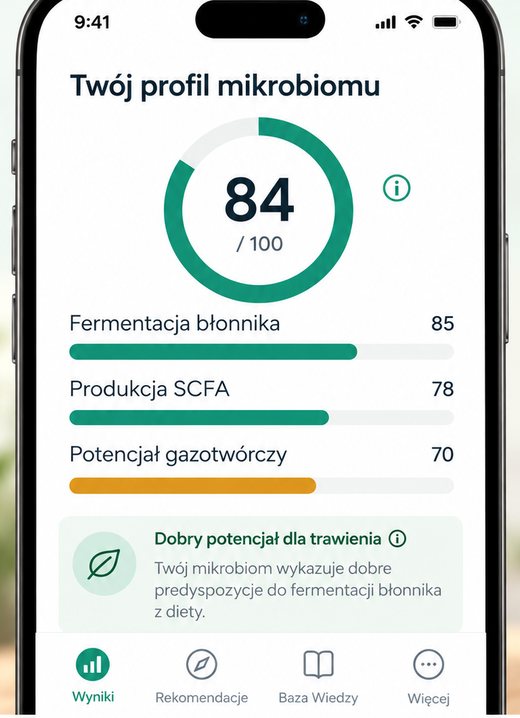
Your Miller
| Presence | detected |
| Relative abundance | [level] |
| Context | [interpretation] |
This is what your Miller looks like in GutLoop
After the test you will see the Miller as part of your individual profile — with related processes: complex polysaccharides → fermentation → metabolites.
- Your result · presence and relative abundance of Bacteroides in your profile.
- Interpretation · what this element may mean in the context of your whole microbiome.
- Related areas · Complex polysaccharides · Fermentation · Metabolites
- Recommendations · always in the context of the whole profile.
This is not a separate “bacterium rating”. It is part of your individual microbiome profile.
The hero’s story · 0:45 · video coming soon
Meet the Miller
“Hi. I’m the Miller. I get the things your body can’t always handle on its own. Big molecules? Give them to me. Complex polysaccharides? Even better. I break them down into smaller components that can be used in further processes. But I’m not a lone mill. In the microbiome everyone produces something, everyone uses something and everyone can affect others. So don’t just ask “how much Bacteroides do I have?”. Check: “how does my whole ecosystem work?”. Now that’s an interesting story.”
The film is a storytelling layer. It is a simplified way of talking about biology — the real microbiome is far more complex.
Want to go deeper?
Articles linked to the hero: science without shortcuts, in language you can understand.
Bacteroides — what do these bacteria do in the gut?
A large, diverse genus: from polysaccharide breakdown to opportunistic behaviour.
Coming soon
Fibre — food for you or for the microbiome?
Why what you don’t digest matters for your gut.
Coming soon
Microbiome and metabolism — how do bacteria process dietary components?
Fermentation in the gut: what really happens there.
Coming soon
You have met part of your team. Your real microbiome is far more complex.
Guardian. Gardener. Chef. Mason. Bodyguard. Miller. Each tells only part of the story. GutLoop helps you move from single bacteria to the whole picture — combining microbiome data, nutrition and your goals with a map of biological relationships. Don’t guess what is going on inside. Get to know your world.